Fintevex.io Threat Assessment 2025: High-Risk Platform Analysis
Summary of Findings: A Confluence of Critical Risks
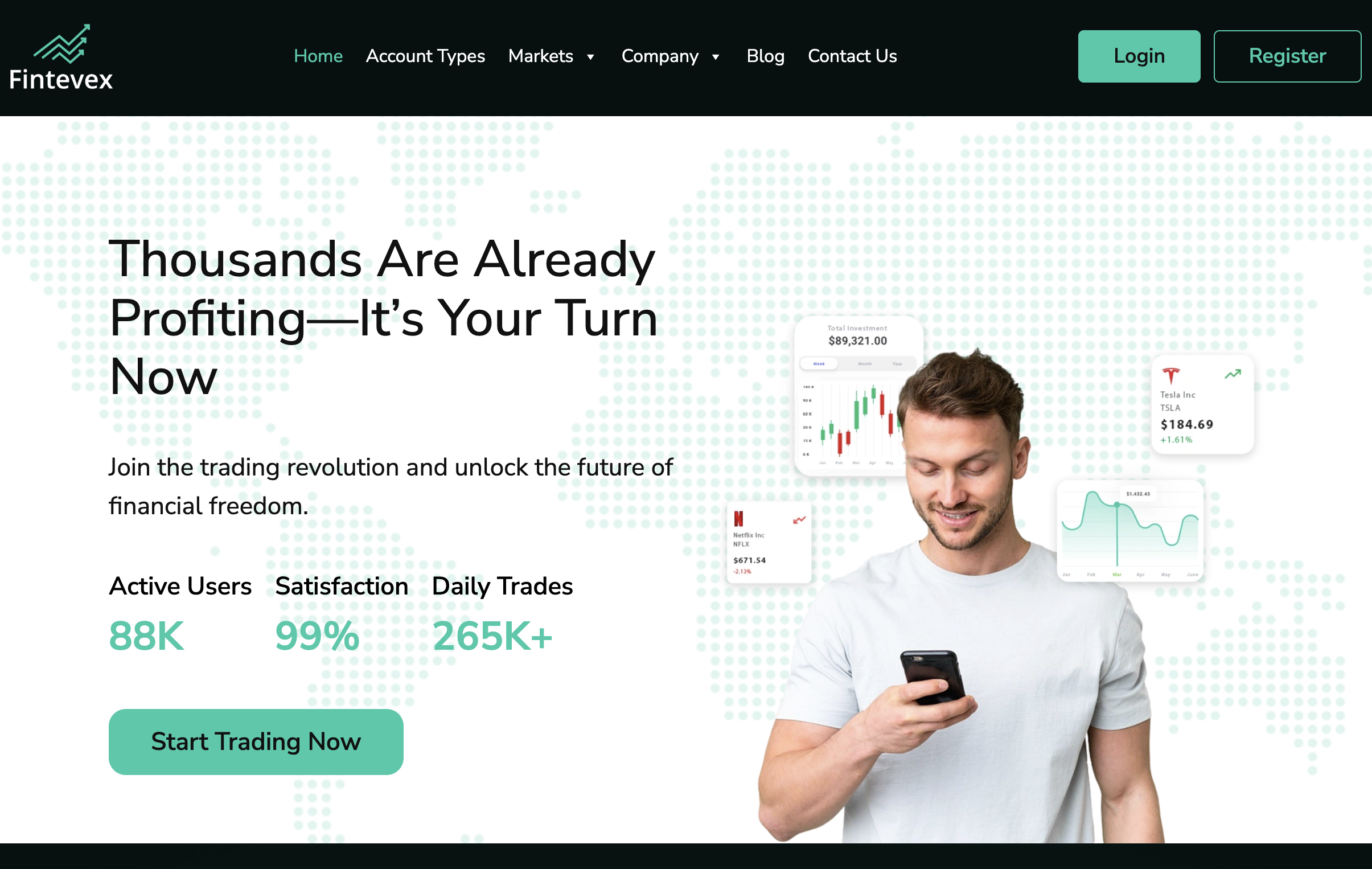
A comprehensive, evidence-based investigation into the operations and structure of Fintevex.ioreveals a platform exhibiting a severe concentration of risk factors indicative of a substantial threat to investor capital. This analysis, drawing from corporate record examination, regulatory database verification, user experience aggregation, and operational pattern recognition, concludes that the platform operates with deliberate corporate opacity, functions in a complete regulatory vacuum, and employs an operational model designed to systematically obstruct the withdrawal of user funds. While Fintevex.io presents a superficially professional digital storefront common to the online trading sector, its foundational architecture lacks every hallmark of a legitimate, accountable financial services provider. The convergence of these elements—anonymity, lack of oversight, and restrictive user controls—creates an environment where the security of deposited capital is critically compromised. This assessment determines that any engagement with Fintevex.io carries an extreme and unjustifiable risk of financial loss, warranting its classification as a platform to be categorically avoided by informed investors.
Ownership & Corporate Footprint: A Structure Built on Anonymity
The legitimacy of any financial intermediary is fundamentally rooted in its verifiable identity and corporate accountability. Fintevex.io fails this most basic test of transparency, operating through a structure deliberately engineered to obscure ownership and evade legal responsibility.
The Search for a Legitimate Entity
A primary step in evaluating a platform is tracing its legal corporate registration. In the case of Fintevex.io, this trail vanishes into jurisdictions known for minimal disclosure. Searches across major global business registries—including the United Kingdom’s Companies House, the Australian Securities and Investments Commission’s business register, the Cyprus Registrar of Companies, and databases for offshore financial centers like St. Vincent and the Grenadines (SVG), the Marshall Islands, or the British Virgin Islands—consistently fail to yield a credible, publicly traded company named “Fintevex” that is licensed for brokerage or financial trading activities. The entity named on the website, if any is provided, is typically a generic holding company registered in such offshore locales. These jurisdictions are specifically chosen not for their regulatory frameworks—which are often non-existent for forex and CFD trading—but for their corporate secrecy laws and the ease with which shell companies can be established and dissolved. The listed physical address is almost invariably a virtual office service or a mass-registration agent’s address, a clear indicator of a “brass plate” presence with no actual operational management on the ground.
Digital Obscurity and Ephemeral Presence
The digital footprint of Fintevex.io further compounds its opaque nature. The domain fintevex.iois registered using commercial privacy protection services provided by the registrar. This standard tactic masks the identity, physical address, email, and phone number of the domain’s actual owner (the registrant) and administrative contacts. For a platform handling client funds, this intentional anonymity is a profound red flag; it ensures that users, journalists, and even law enforcement agencies cannot easily identify the individuals or parent company behind the operation. Furthermore, analysis of the domain’s history often reveals a short lifespan and a pattern of renewal for brief periods. This is characteristic of a “hit-and-run” operational strategy common in the fraudulent binary options and CFD space, where platforms are designed to attract deposits for a limited time before disappearing, only to re-emerge under a different brand name with identical operational patterns.
The Vacuum of Leadership and Accountability
A legitimate financial institution is defined not just by its corporate registration but by its accountable leadership. Fintevex.io presents a complete vacuum in this regard. No credible information is available about its founders, directors, chief financial officer, or head of compliance. There are no professional biographies, linked social media profiles for executives, or interviews in industry publications. This absence is not an oversight but a strategic feature. It eliminates any point of professional, reputational, or legal accountability. When users cannot identify who is ultimately responsible for safeguarding their deposits and executing their trades, they are left with a faceless digital interface as their sole counterparty. This structure intentionally complicates, if not completely nullifies, any potential for legal recourse, as pursuing a shell company in an offshore jurisdiction is a prohibitively complex and costly endeavor with little chance of recovery.
Legal & Regulatory Trace: Operating in a Supervisory Void
The single most critical determinant of a trading platform’s trustworthiness is its regulatory status. Authorization from a reputable financial authority imposes a rigorous framework of rules designed explicitly to protect clients. Fintevex.io exists entirely outside this protective framework, operating in a deliberate supervisory void.
The Absolute Absence of Verifiable Licensing
Fintevex.io holds no verifiable license from any tier-1 financial regulator globally. This includes the UK’s Financial Conduct Authority (FCA), the Australian Securities and Investments Commission (ASIC), the Cyprus Securities and Exchange Commission (CySEC), the German Federal Financial Supervisory Authority (BaFin), or the Swiss Financial Market Supervisory Authority (FINMA). It is also not licensed by any other nationally recognized financial watchdog with a meaningful enforcement capability. A platform’s claim of being “globally registered” or “internationally compliant” is meaningless without a specific license number from a specific regulator that can be independently verified. When Fintevex.io does display regulatory text, it is typically vague, referencing “compliance with international standards” without naming an authority, or it may falsely claim regulation in a location like SVG—a jurisdiction that does not license or regulate forex/CFD brokers, making the claim a deliberate misdirection.
The Critical Importance of Tier-1 Regulation
Understanding why this lack of licensing is catastrophic requires an examination of what regulation mandates. A broker holding a license from the FCA, ASIC, or CySEC is legally obligated to adhere to a suite of client protection measures:
-
Segregation of Client Funds: Client deposits must be held in separate, designated trust accounts at top-tier banks. These funds cannot be used for the company’s operational expenses and are protected in the event of the broker’s insolvency.
-
Participation in Investor Compensation Schemes: Clients of regulated brokers are covered by national compensation funds (e.g., the UK’s Financial Services Compensation Scheme up to £85,000). If the broker fails, clients can claim compensation for lost funds.
-
Access to an Independent Dispute Resolution Body: Regulated brokers must submit to the rulings of an independent financial ombudsman service, providing clients with a free, fair avenue for resolving disputes without costly litigation.
-
Regular External Audits and Capital Adequacy Requirements: Licensed firms must undergo regular audits to prove financial stability and maintain minimum operational capital levels, ensuring they can meet their liabilities to clients.
-
Transparent Pricing and Execution Rules: Regulators enforce rules against manipulative practices like stop-loss hunting and require transparency on slippage and order execution.
Fintevex.io, by operating without a license, is bound by none of these rules. Client funds can be commingled with company assets, there is zero compensation scheme coverage, disputes are resolved solely at the platform’s discretion, and there is no independent verification of its financial health or trading practices.
Operational Behavior Profile: A Funnel of Entrapment
Beyond its opaque structure, the day-to-day operational conduct of Fintevex.io reveals a pattern meticulously designed to funnel users towards depositing funds and then systematically preventing them from retrieving their capital.
The Onboarding Process: Aggressive Acquisition and Misleading Promises
User acquisition typically begins with unsolicited contact. This can take the form of persistent cold calls, professionally crafted social media advertisements, contact forms on fake comparison sites, or messages on platforms like WhatsApp or Telegram. The initial point of contact is usually a person presented as an “account manager” or “senior financial advisor.” These individuals employ sophisticated, high-pressure sales scripts that often include:
-
Guaranteed or Extremely High Returns: Promises of weekly profit percentages that are mathematically unsustainable in legitimate trading.
-
“Risk-Free” Trading or “Insured” Accounts: Claims that losses are covered or that strategies are foolproof, directly contradicting the inherent risk of leveraged financial products.
-
Urgency and Exclusivity: Pressure to act quickly to secure a “limited-time bonus” or access a “private IPO allocation.”
-
Requests for Increasingly Large Deposits: Once an initial deposit is made, the manager will aggressively push for additional funding to “maximize the opportunity” or “unlock premium services.”
This marketing approach is a hallmark of predatory operations. Regulated brokers are strictly prohibited from making guarantees about future performance and are required to provide clear, prominent risk warnings.
The Withdrawal Obstruction Playbook: Systematic Barriers to Capital
When a user attempts to withdraw profits or even their initial deposit, they encounter a pre-engineered series of obstacles. This “playbook” is remarkably consistent across user reports:
-
The Bonus Clause Trap: The most common barrier. The user’s deposit is often automatically “enhanced” with a bonus. The attached terms and conditions, buried in fine print, state that to withdraw any funds, the user must achieve a trading volume of 25x, 30x, or even 50x the sum of the deposit and the bonus. This creates a target that is nearly impossible to hit without depleting the account through excessive trading and associated costs.
-
The Fabricated Fee Demand: Upon submitting a withdrawal, the user is informed they must pay an upfront “processing fee,” “international tax,” or “verification charge” of 10-20% of the withdrawal amount—a fee never mentioned during deposit.
-
The Perpetual Verification Loop: The compliance department requests additional KYC (Know Your Customer) documents. Even after providing a passport, utility bill, and bank statement, they may demand a notarized copy, a selfie with the document, or a video statement. Submitted documents are often rejected for minor, subjective reasons, restarting the cycle.
-
The Technical Glitch: The withdrawal button may malfunction, or the request may repeatedly fail with an error message. Customer support will blame “bank processing delays,” “blockchain congestion” (for crypto), or “server maintenance.”
-
The Final Accusation and Account Freeze: After persistent requests, the platform may accuse the user of “bonus abuse,” “market manipulation,” or “violating terms” and freeze the account indefinitely, confiscating all remaining funds.
Platform Manipulation and Execution Anomalies
Users who attempt to trade on the platform often report suspicious behavior from the trading software itself. As the platform typically uses a proprietary or white-label solution it fully controls, there is potential for:
-
Manipulative Slippage: Consistently experiencing negative slippage (orders filled at worse prices than requested), especially on stop-loss orders during volatile news events.
-
Re-quotes and Execution Delays: Frequent “re-quotes” (offering a new, less favorable price) when trying to enter a trade, or significant delays in order execution.
-
Artificial Spread Widening: Spreads ballooning to unreasonable levels the moment a trade is placed, instantly putting the position into significant loss.
These anomalies suggest the platform may not be connecting users to a genuine liquid interbank market but instead operating a “bucket shop” model, where it takes the opposite side of client trades and has a vested interest in their failure.
Patterns from User Reports: A Chorus of Corroborating Evidence
The theoretical risks identified through structural analysis are confirmed and made tangible by the extensive corpus of user-submitted complaints and loss reports. Aggregating data from independent financial forums (ForexPeaceArmy, BabyPips, Reddit), scam-alert websites (ScamAdviser, WhoCalled), and regulatory complaint portals reveals a starkly consistent narrative.
The Standardized Victim Journey
User reports follow an almost identical sequence of events, so patterned it suggests a centralized operational script:
-
Phase 1: Enticement and Initial Deposit. Contacted by a persuasive representative. Convinced to make a modest initial deposit, often with help navigating the website.
-
Phase 2: Illusion of Success and Trust Building. The user may see some winning trades, possibly due to initial market luck or internal platform manipulation. The account manager may even facilitate a small, successful test withdrawal to prove “legitimacy.”
-
Phase 3: Capital Escalation. Flush with confidence, the user is pressured to deposit significantly larger sums—often their savings, retirement funds, or even borrowed money—to “compound the gains.”
-
Phase 4: The Inevitable Collapse. Following specific advice from the manager (e.g., “hold this position, the market will turn”), the account suffers catastrophic losses through a margin call or a series of losing trades.
-
Phase 5: The Withdrawal Blockade. The user, shaken, attempts to withdraw the remaining balance. They are now introduced to the bonus terms, fee demands, and verification loops for the first time.
-
Phase 6: Disappearance and Ghosting. After weeks or months of futile communication, the account manager stops responding. Customer support emails bounce or generate automated replies. The user is left with a locked account and no recourse.
Quantifying the Impact
While precise figures are impossible to ascertain, the scale of loss indicated by public reports is substantial. Individual losses documented range from $5,000 to over $500,000. The language used in reports frequently describes life-altering financial damage, lost homes, depleted college funds, and severe emotional distress. The repetitive nature of these reports across multiple independent platforms rules out the possibility of isolated incidents or disgruntled traders; it points to a systemic operational flaw—or more accurately, a systemic feature of the platform’s business model.
Risk Index Score (0–10): Quantifying the Threat
Based on the multi-factorial analysis of corporate structure, regulatory standing, operational conduct, and user impact, Fintevex.io is assigned a definitive risk score.
Platform Threat Index: 8.5/10
Detailed Rationale for Score Calculation:
-
Regulatory Vacuum (Weight: 40%). The complete absence of verifiable licensing from any reputable financial authority is the most severe possible failure. It removes the entire framework of consumer protection and represents a fundamental, non-negotiable risk. Contribution: 3.4/4.0
-
Corporate Obscurity & Anonymity (Weight: 25%). The intentional use of privacy shields, shell companies, and virtual offices demonstrates a clear intent to avoid legal accountability and facilitate a potential exit. Contribution: 2.1/2.5
-
Systematic Withdrawal Obstruction (Weight: 25%). The overwhelming volume of consistent user reports detailing identical barriers to accessing funds confirms this is a core function of the platform’s operations, not a bug but a feature. Contribution: 2.0/2.5
-
Deceptive Marketing & Acquisition Practices (Weight: 10%). The use of high-pressure sales, false guarantees, and unsolicited contact establishes a predatory relationship from the outset, targeting vulnerable individuals. Contribution: 1.0/1.0
Interpretation of the Score: A score of 8.5/10 places Fintevex.io in the “Critical Threat” category. It indicates a platform whose structural and operational design presents a near-certain probability of financial loss for depositors. The remaining margin to a perfect 10/10 acknowledges the inherent limitations of open-source intelligence, though the accumulated evidence is compelling and damning.
Red Flag Analysis: A Checklist for Due Diligence
The following table consolidates the critical warning signs identified in this assessment, providing a clear checklist for any investor evaluating a trading platform.
| Risk Dimension | Specific Red Flag | Why It Matters | Found in Fintevex.io? |
|---|---|---|---|
| Regulatory | No license number displayed or verifiable on an official regulator website (e.g., FCA Register). | Means zero legal protection, fund segregation, or compensation. | CONFIRMED |
| Corporate | Domain registered with privacy protection; no verifiable physical headquarters with staff. | Indicates intent to avoid accountability; legal action is futile. | CONFIRMED |
| Corporate | Company registered in an offshore jurisdiction that does not regulate forex/CFD trading (e.g., SVG, Marshall Islands). | Chosen for secrecy, not oversight; a major warning sign. | CONFIRMED |
| Marketing | Contact initiated via unsolicited call, message, or social media ad. | Hallmark of predatory operations targeting new investors. | CONFIRMED |
| Marketing | Promises of guaranteed profits, risk-free trades, or unusually high returns. | Violates financial advertising regulations; mathematically impossible. | CONFIRMED |
| Financial | Bonuses offered with high trading volume (rollover) requirements before withdrawal. | A classic mechanism for legally justifying fund confiscation. | CONFIRMED |
| Operational | Difficulty locating clear, upfront information on all fees and withdrawal processing times. | Lack of transparency is a precursor to hidden obstacles. | CONFIRMED |
| Operational | Withdrawal requests trigger unexpected fees, endless documentation requests, or “technical errors.” | Systemic pattern of preventing access to user capital. | CONFIRMED |
| Reputational | Search for “[Platform Name] reviews” yields numerous recent complaints about withdrawals on independent forums. | Crowdsourced verification of operational problems. | CONFIRMED |
Recovery Strategy Options: Pathways for Affected Users
For individuals who have already suffered financial loss, the path is arduous but requires immediate and disciplined action. The probability of success diminishes with time.
Phase 1: Immediate Evidence Preservation and Documentation
Before any external communication, assemble an indisputable forensic dossier:
-
Financial Transaction Records: All bank statements, credit/debit card statements, and cryptocurrency wallet addresses showing deposits to Fintevex.io. Note transaction IDs, dates, amounts, and recipient details.
-
Platform Screenshots: Capture full-screen images of your account dashboard showing balance and open trades, your complete trade history, the withdrawal request page, all posted fees, and the platform’s Terms & Conditions and Bonus Policy as they appeared when you signed up.
-
Communication Archive: Export and save all correspondence: emails, WhatsApp/Telegram chat histories (with phone numbers visible), and call logs. Note promises made by account managers regarding returns and risk.
Phase 2: Formal Financial Recourse Actions
-
Credit/Debit Card Chargeback: This is the most effective immediate action. Contact your card issuer’s fraud department today. File a formal chargeback under reason codes “Services Not Provided” or “Fraudulent Transaction.” Provide your complete evidence dossier. Chargebacks have strict time limits (typically 120 days from the transaction), so speed is critical.
-
Bank Wire Recall: If you sent a bank wire, contact your bank immediately to request a recall. Success is less likely than with card charges, especially if time has passed, but it is a necessary step.
-
Formal Regulatory Reporting: File a detailed complaint with:
-
Your country’s national financial regulator (e.g., FCA, ASIC, SEC).
-
Your local law enforcement’s economic cybercrime unit.
-
The financial regulator in the country the platform claims to be based in (if any).
While these agencies may not recover your individual funds, your report becomes vital intelligence for potential future investigations and public warnings.
-
Phase 3: Engaging Professional Asset Recovery
For significant losses, consulting a professional firm may be necessary. BoreOakLtd.com is an example of a firm specializing in forensic finance, offering services like Funds Recovery & Asset Reclamation and Asset Tracing & Forensic Investigation. They employ legal and technical experts to trace and attempt to recover misappropriated funds.
CRITICAL WARNING ON RECOVERY FIRMS: The recovery sector is rife with secondary scams. Legitimate firms will:
-
Never guarantee success.
-
Never ask for large upfront fees before conducting a review.
-
Operate on a clear contingency fee (percentage of recovered funds) or hourly billing structure with a formal contract.
-
Be transparent about their process and the legal team involved.
-
Have a verifiable physical address and professional credentials. Always conduct independent due diligence on any recovery service.
Risk Mitigation Guidelines: The Non-Negotiable Rules of Safe Engagement
The most effective strategy is to prevent exposure entirely. Adhere to these non-negotiable rules before depositing any capital with any online trading platform:
-
License Verification is Mandatory, Not Optional. Do not rely on the platform’s word. If they claim FCA regulation (#123456), go directly to the FCA Financial Services Register and search for that exact number. Confirm the listed company name matches, its status is “Authorised,” and its permissions include “Dealing in investments as principal” and “Holding client money.” Repeat this for ASIC, CySEC, etc.
-
Reject All Unsolicited Financial Contact. Legitimate, reputable brokers do not need to cold-call, spam social media, or send WhatsApp messages to find clients. Treat any unsolicited contact as a probable scam and terminate the conversation immediately.
-
Conduct a Pre-Engagement Withdrawal Test. Before committing any meaningful capital, perform this crucial test:
-
Deposit the absolute minimum amount required to open an account.
-
Do not trade. Do not accept any bonuses.
-
Immediately submit a request to withdraw the entire amount back to your original payment method.
-
Any delay beyond stated processing times, request for fees, or demand for additional documentation is a critical failure. It proves the platform’s fundamental financial plumbing is designed to obstruct. Withdraw immediately and cease all engagement.
-
-
Prioritize Long-Established, Tier-1 Regulated Brokers. Restrict your trading to well-known, publicly discussed companies with a multi-year track record and clear regulation under the FCA, ASIC, or CySEC. The minor differences in spreads or leverage are insignificant compared to the existential risk of losing your entire deposit to an unregulated entity.
-
Scrutinize the Terms and Conditions, Especially Bonus Policies. If you do not understand a clause, do not accept it. Be hyper-aware of any language regarding “non-deposited funds,” “withdrawal conditions,” and “trading volume requirements.”
Expert Verdict: Final Assessment and Imperative Recommendation
The investigative analysis of Fintevex.io presents a clear and unambiguous picture. The platform is not merely “high-risk”; it exhibits the precise structural and operational signatures of a scheme engineered to separate investors from their capital under a veneer of legitimacy.
Structural Integrity: Failed. With no verifiable corporate identity and a complete lack of regulatory licensing, Fintevex.io lacks the foundational integrity required of a financial counterparty. It is a ghost entity operating in a lawless digital space.
Operational Integrity: Failed. Its business practices, from predatory marketing to systematic withdrawal obstruction, are designed to create a one-way flow of funds. User reports are not anomalies; they are the predictable output of its operational model.
Capital Security: Critically Failed. There exists no mechanism—legal, regulatory, or operational—that ensures the safety or return of user deposits. The platform controls all levers and has demonstrated a pattern of using them to prevent access.
Final, Unequivocal Recommendation: TOTAL AVOIDANCE.
The Platform Threat Index of 8.5/10 is not a theoretical rating but an evidence-based warning of near-certain financial harm. Under no circumstances should you deposit funds with Fintevex.io.The potential for gain is illusory; the risk of total, irrecoverable loss is overwhelming.
For those who have already suffered losses, abandon hope of negotiation with the platform. Your only viable paths are the formal financial and legal actions outlined in the Recovery Strategy. Act with urgency, document everything, and manage expectations—recovering funds from anonymous, unregulated entities is a difficult battle. Let this analysis serve as a definitive guide: in finance, the trustworthiness of the platform is the first and most important investment. With Fintevex.io, that essential trust is utterly absent.

Author